Measures to be critiqued could include projective tests, tests in magazines and books, lie detectors, self-monitoring tests, student evaluation forms, SATs, or IQ tests.
Briggs, S. R. & Cheek, J. M. (1988). On the nature of self- monitoring:
Problems with assessment, problems with validity. Journal ofPersonality and Social Psychology, 54, 663-678.
Gould, S. J. (1981). The mismeasure of man. New York: Norton.
Lykken, D. T. (1981). A tremor in the blood: Uses and abuses
of the lie detector
. New York: McGraw-Hill.
Robinson, J. P., Shaver, P. R., & Wrightsman, L. S. (1991).
Measures of personality and social psychologicalattitudes. New York: Academic Press.
Sternberg, R. J. (1986). Intelligence applied. New York: Harcourt Brace.
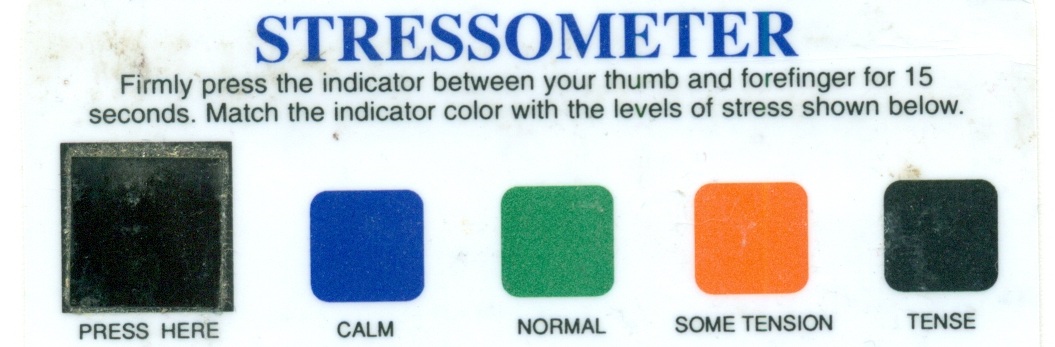
You could even have students evaluate the "stressometer." You or your students can download the free Android app from here , buy a card from here (the card itself costs less than a dollar) or just show them a picture of the stress-o-meter card (see below). It is interesting that the same card is sold as a "stress card," "mood card," and "love card." The card responds to body temperature which is claimed to reflect mood.
Alternatively, you could discuss the interesting case of Duncan MacDougall's (1907) attempt to measure the weight of the soul. As you can see from this 30-second video, MacDougall concluded that the soul weighed 23 grams. His study raises several issues:
To learn more about MacDougall's study, you can consult critiques of that study from
The reference for the original article is
MacDougall, D. (1907). Hypothesis concerning soul substance together with experimental evidence of the existence of such substance.
American Medicine, 2(4), 240-243.